


The Poison In The Pan: Metabolic Health, Food Chemistry, and Chronic Disease
Two parts: how to weigh a contested health argument, then the evidence on lipid chemistry, heart-disease data, and food regulation
- 7 guides
- 146 flashcards
- 37-question quiz
- Video, 12 min
- Audio, 50 min
Second video lesson · 14 min
Part 2: The metabolic health evidence: video overview
About this module
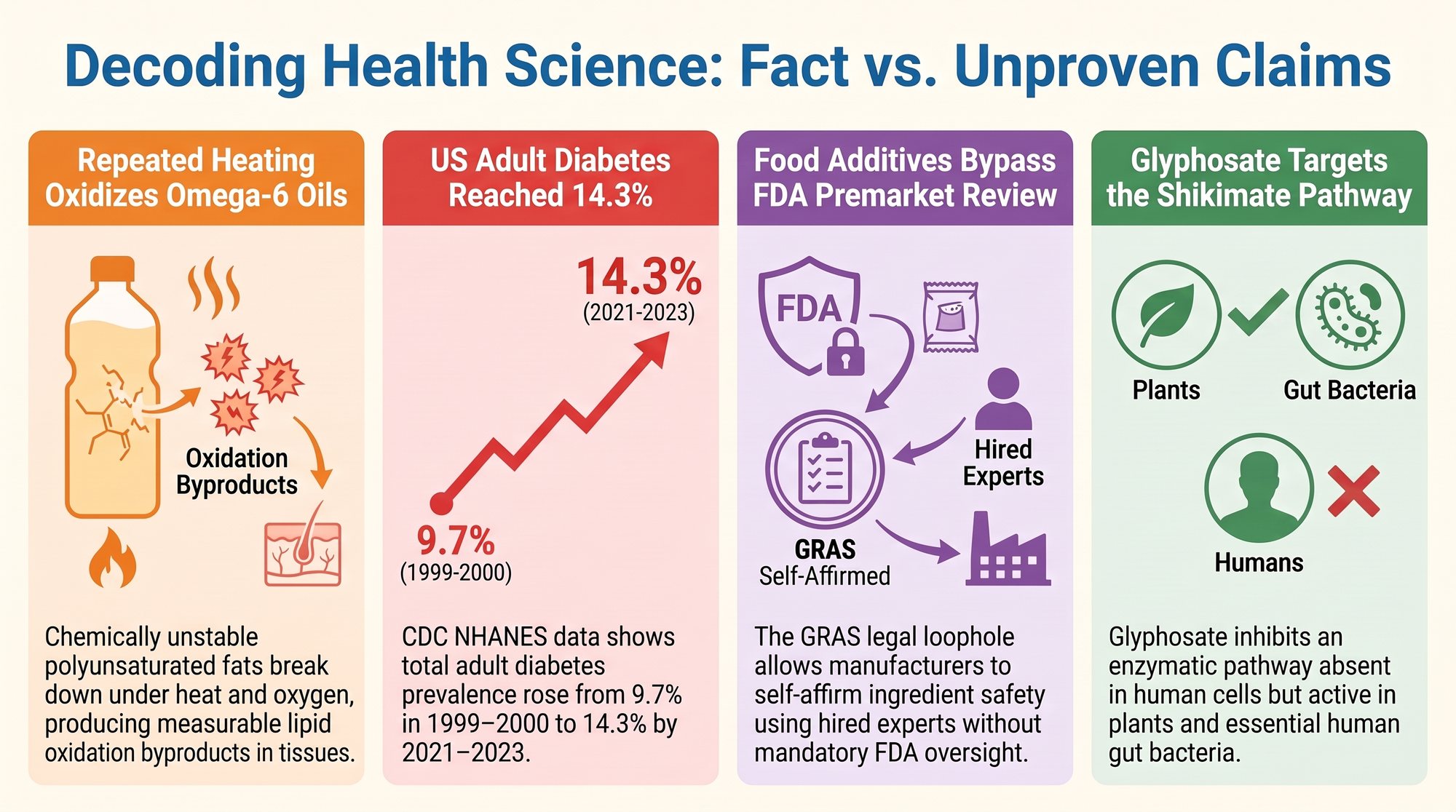
Public arguments about seed oils, cholesterol, and chronic disease tend to arrive as two loud camps. This module is in two parts. Part 1 builds the posture for weighing a contested scientific claim: two true readings of one label, proxies versus hard outcomes, population averages versus individuals, and bias tests applied symmetrically. Part 2 applies it to the evidence, grading each claim as documented fact, established mechanism, contested position, confounded correlation, or unsupported: from lipid oxidation and the LDL-C versus particle-count question to the French Paradox arithmetic, the pre-1920 diagnostic gap, glyphosate, antibiotics and the microbiome, and the GRAS and user-fee regulatory structures. Educational content, not medical advice.
Topics covered
- Holding a Contested Scientific Argument
- Seed Oil Chemistry & Lipid Oxidation
- LDL-C, LDL-P & ApoB: Mass vs. Particle Count
- Foam Cells & Atherosclerosis
- The French Paradox & Epidemiological Arithmetic
- Diagnostic Eras & Historical Heart Disease Data
- GRAS, User Fees & Regulatory Capture
- Glyphosate, Antibiotics & the Microbiome
Study materials
Open in the reader · the original file is one click further
- Part 1 · Executive Briefing: Frame, Posture, and Methodological Rigor in Scientific Debates1 sheet · The marketing layer versus the science layer of a public scientific debate↓
- Part 1 · Study Guide: How to Hold the Seed Oil and Cholesterol Argument1 sheet · Glossary of 15 key terms (ApoB, LDL-P, design-stage bias, the hermeneutic circle and more)↓
- Part 1 · Slide deck: How to Hold a Contested Scientific Argument12 slides · Two true readings, the iceberg of the middle, proxies versus outcomes, aim-bias, defensiveness, and the eight-point posture dashboard↓
- Part 1 · Full report: Navigating Nutrition Science Debates21 pages · The written Part 1 report: seven lessons, study guide, and executive briefing↓
- Part 2 · 6 Counter-Intuitive Truths About Food Chemistry, Heart Disease, and Science1 sheet · The six takeaways and their core synthesis↓
- Part 2 · Briefing Document: Metabolic Health, Food Chemistry, and Chronic Disease Synthesis1 sheet · Evidentiary-status ledger for 25 claims, from PUFA oxidation to regulatory capture↓
- Part 2 · Slide deck: Compounding Load, a Sourced Research Synthesis14 slides · The evidentiary tiers, the France Paradox arithmetic, the diagnostic shadow timeline, glyphosate, antibiotics, and the master evidentiary ledger↓
- Part 2 · Slide deck: The Mineralogist's Examination of Modern Metabolic Health21 slides · Lipid chemistry, the diet-heart origins, the France Paradox, diagnostic baselines, glyphosate, antibiotics, regulatory architecture, and epistemology↓
- Part 2 · Slide deck: Metabolic Health Research Dossier20 slides · The hermeneutic circle, the evidentiary taxonomy, the lipidology paradigm matrix, and a master diagnostic matrix↓
- Part 2 · Slide deck: Metabolic Health Research Synthesis21 slides · Seed oil chemistry, the France Paradox math, the glyphosate split, antibiotics and the limits of causation, and two master synthesis matrices↓
- Part 2 · Full report: Metabolic Health, Food Chemistry, and Chronic Disease26 pages · The written Part 2 report: six truths, briefing document, and study guide↓
Audio explainer · 50 min
Part 1: How to analyze seed oil research
Second audio explainer · 1 hr 17 min
Part 2: Why standard bloodwork misses chronic disease
Guide 1 of 7
Read First: Educational Content, Not Medical Advice
What this module is and is not, how its two parts fit together, how Part 2 grades each claim, and the method behind both parts.
Educational content, not medical advice
This module is educational. It explains how scientists, regulators, and commentators argue about food chemistry, cholesterol, and chronic disease, and it teaches a method for weighing that evidence. It is not medical advice, diagnosis, or treatment, and nothing in it should change your medications, your tests, or your care. Talk with a qualified clinician about your own health.
The numbers in this module (mortality rates, diabetes prevalence, and so on) describe populations. Part 1 is explicit that an average effect from a crowd study is a statistical fact about a population, not a personalized prediction about your body.
How the two parts fit together
- Part 1, Holding the Argument: the precursor. It builds the posture needed to weigh a contested scientific claim before looking at any evidence: two true readings of one label, proxies versus hard outcomes, population averages versus individuals, bias tests applied symmetrically, and why total certainty with no seams is a warning sign.
- Part 2, The Evidence: the companion. It puts those tools to work on lipid oxidation and the LDL-C versus particle-count question, the French Paradox arithmetic, US heart disease history and the pre-1920 diagnostic gap, US diabetes and pediatric trends, the GRAS and user-fee regulatory structures, glyphosate, antibiotics and the microbiome, and the difference between the scientific method and institutional consensus.
Start with Part 1. The source material says its explicit function is to establish the critical posture before the companion evidence is heard. The audio, video, and study materials are labeled by part, and the flashcards and quiz list the Part 1 items first.
How claims are graded in Part 2
- Documented Fact: primary-source statistics, legal structures, or verified historical events.
- Established Mechanism: textbook-level biochemistry and physiological pathways.
- Contested Minority Position: legitimate, credentialed scientific arguments that diverge from mainstream consensus.
- Correlation, Confounded: real statistical associations accompanied by documented, competing explanations.
- Weak / Not Supported: claims that fail under empirical or methodological scrutiny.
The method: the hermeneutic circle
The material relies on the hermeneutic circle: reading each individual part against the whole context, and checking the whole context against each individual part. In practice, no single claim is accepted because the overall story is appealing, and the overall story is only as strong as the claims that survive on their own.
What this module does not do
Part 1 states that its purpose is not to settle the debate on seed oils or cholesterol, nor to declare a winning side. Part 2 grades each claim rather than choosing a camp, and it labels some items as a host's stated perspective rather than a finding. Where the material says a claim is unproven, contested, or confounded, it means exactly that.
Module quiz
Test what you have learned
37 questions, one at a time, with the reasoning behind each answer. Score 80% or better to pass.
Tip: press 1–4 to answer, Enter to continue.
Flip the card before grading it.
Prefer paper? Print the whole module as a study packet, or save it as a PDF.
Your notes
Kitchen notebook
Level 1
Prep Cook
- First Page
- Passed
- Perfect Score
- Three-Day Streak
- Week Strong
- Module Master
- Card Shark
- Estate Scholar


